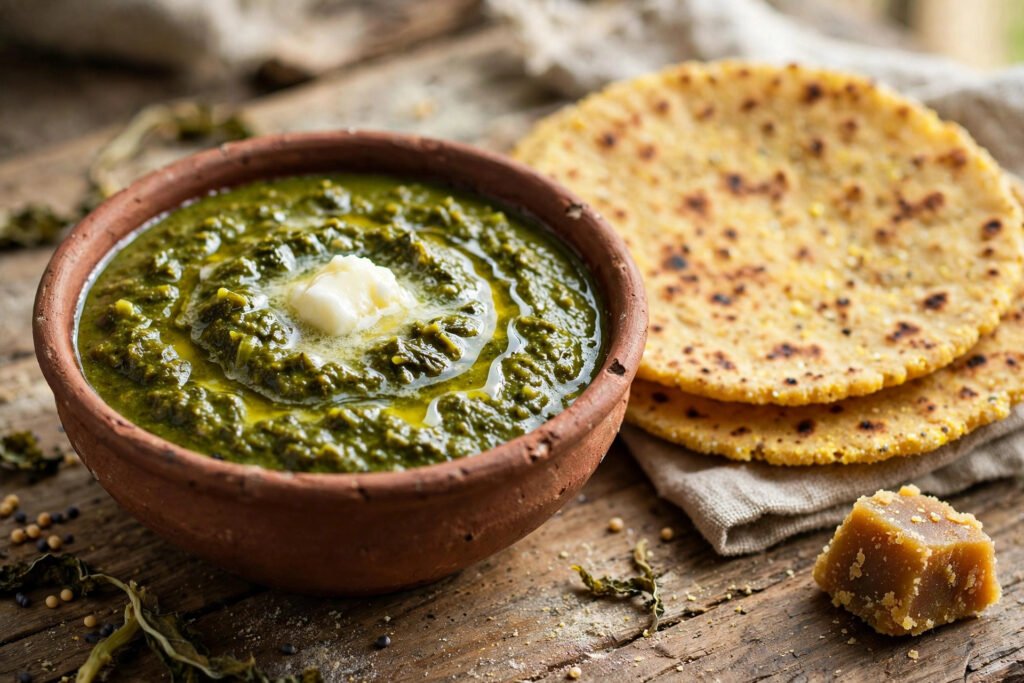
Sarson ka saag is the pride of Punjabi winters. When mustard greens flood the vegetable markets in December and January, this slow-cooked saag recipe becomes the most loved dish on family dining tables across Punjab. Served with fresh makki di roti, a dollop of white butter, and a piece of gur (jaggery) on the side, it is a meal that needs nothing else.
In villages, sarson da saag is cooked the traditional way — pounded by hand in a big brass deg and simmered for hours over a low flame. This home recipe keeps that same rich flavor but makes it doable in a regular kitchen with a simple pressure cooker and hand blender.
Prep Time: 30 minutes | Cook Time: 1 hour 45 minutes | Servings: 5–6
Why This Sarson ka Saag Recipe Works
The secret of a good saag is the mix of greens. Pure sarson (mustard greens) can taste bitter, so Punjabi homes always blend it with bathua (white goosefoot) and a little palak (spinach). The bathua adds earthiness, the palak adds body, and together they balance the mustard’s sharpness. A little cornmeal (makki ka atta) stirred in at the end gives the saag its classic thick, velvety texture.
Ingredients:
For the saag:
- 1 kg fresh sarson (mustard greens), washed and roughly chopped
- 250 g bathua (white goosefoot), washed and chopped
- 250 g palak (spinach), washed and chopped
- 4–5 green chilies, chopped
- 1-inch piece of ginger, roughly chopped
- 1 tsp salt (or to taste)
- 4 cups water
- 3 tbsp makki ka atta (cornmeal)
For the tadka (tempering):
- 4 tbsp desi ghee (or white butter)
- 1 tbsp garlic, finely chopped
- 1 medium onion, finely sliced (optional)
- 1 tsp red chili flakes
- 1/2 tsp cumin seeds
For serving:
- Fresh makki di roti
- White butter or ghee
- Gur (jaggery) pieces
Instructions:
- Clean and chop the greens: Pick through the sarson, bathua, and palak. Remove any thick, woody stems, wash everything in 3–4 changes of water until the water runs clear, then chop roughly. Wash bathua carefully — it hides a lot of dust.
- Pressure cook the greens: Add all the chopped greens to a large pressure cooker with the green chilies, ginger, salt, and 4 cups of water. Close the lid and cook for 6–7 whistles on medium heat (about 25 minutes). Let the pressure release naturally.
- Mash the saag: Open the cooker and mash the cooked greens. Traditionally this is done with a wooden churner (madhani) — you can use a potato masher or a hand blender, but pulse it roughly; the saag should stay a little coarse, never silky smooth.
- Thicken with cornmeal: Put the cooker back on low heat. Sprinkle the makki ka atta over the saag and stir continuously for 5 minutes so no lumps form. This thickens the saag and gives it that classic texture.
- Slow simmer: Cover and cook on the lowest flame for 30–40 minutes, stirring every 10 minutes. The saag will darken to a deep green and the flavors will deepen. This slow step is what makes the difference between average and great saag.
- Prepare the tadka: In a small pan, heat the desi ghee. Add cumin seeds, then the garlic, and fry until golden. Add the sliced onion and cook until soft and lightly browned. Finish with red chili flakes.
- Combine and serve: Pour half the hot tadka into the saag and mix. Transfer to a serving dish and drizzle the remaining tadka on top. Serve hot with makki di roti, a knob of white butter melting on the saag, and gur on the side.
Tips:
- Balance the bitterness: If your saag tastes too bitter, stir in an extra spoon of makki ka atta and simmer 10 more minutes — or add a small piece of gur while cooking.
- Don’t rush the simmer: The 30–40 minute low-heat simmer is the soul of this dish. Rushing it leaves the saag grassy and raw-tasting.
- Frozen greens work too: Outside winter, frozen chopped mustard greens from the supermarket work fine — reduce water slightly since frozen greens release more moisture.
- Bathua substitute: If you can’t find bathua, use extra palak plus a handful of radish leaves (mooli ke patte) for a similar earthy flavor.
- Reheats beautifully: Saag tastes even better the next day. Store up to 3 days in the fridge and reheat with a spoon of ghee.
FAQs:
Why is my sarson ka saag bitter?
Pure mustard greens are naturally sharp. Using too little bathua or palak is the usual cause — keep the ratio roughly 4 parts sarson to 1 part bathua and 1 part palak. Overcooking without enough simmering time can also leave a bitter, raw edge; the long low simmer mellows it.
Why is my saag not green but dark brown?
Some darkening is normal — well-simmered sarson ka saag turns deep olive-green. But if it goes muddy brown, the greens were likely overcooked in the pressure cooker or scorched at the bottom. Stir often during the final simmer and keep the flame truly low.
Can I make sarson ka saag without bathua?
Yes, you can make it with just sarson and palak, though purists will say it is not the real thing. To compensate for the missing bathua, use 750 g sarson and 500 g palak, and consider adding a small handful of mooli ke patte (radish leaves) if available.
Serve this sarson ka saag recipe with hot makki di roti straight off the tawa, a generous knob of white butter, and gur — the full Punjabi winter meal that has warmed generations.